How to Start a Cover Letter With Clear Examples
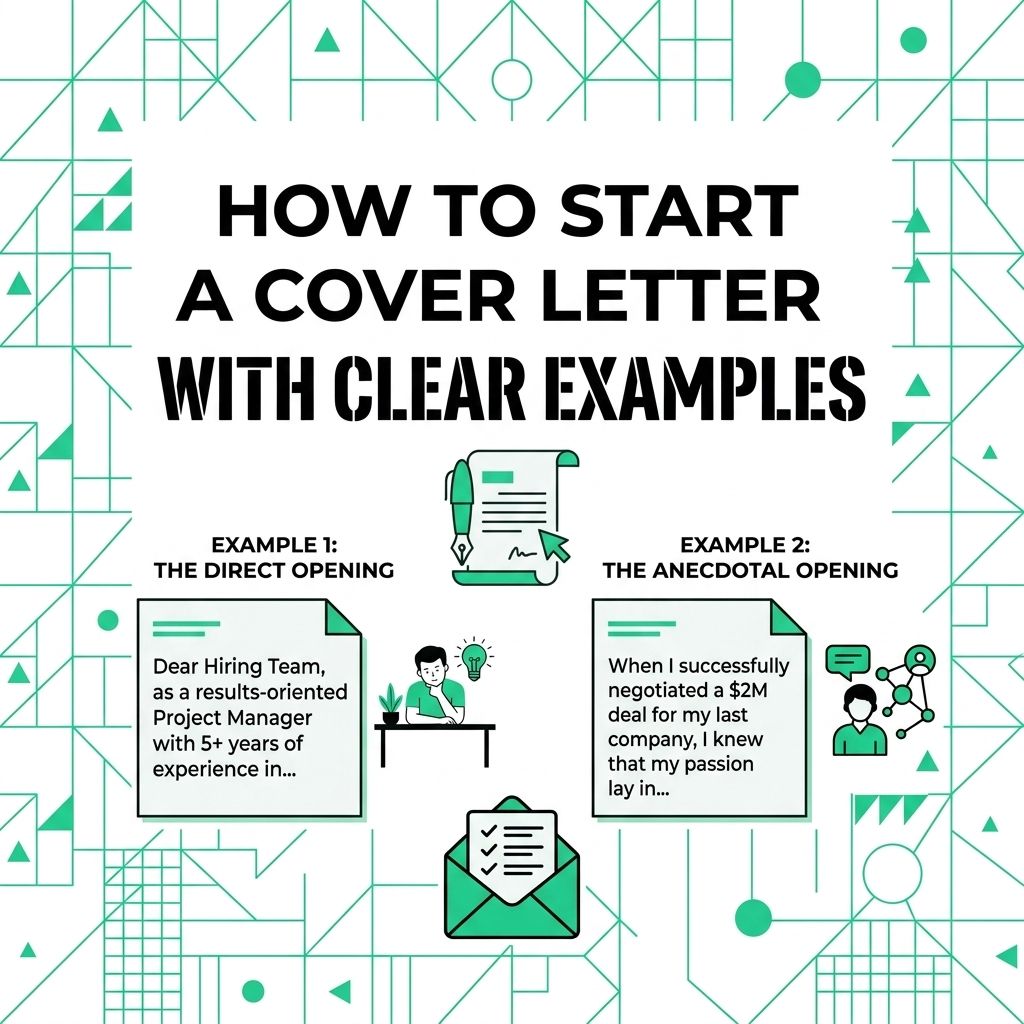
Give the first paragraph 10 minutes. Its job is to name the role, show one reason you fit, and give the reader a specific reason to continue. That matters even more for remote roles, where your opening can prove that you communicate clearly without relying on a face-to-face introduction.
Start by choosing your strongest proof, then match it to one of the opening formulas and examples below. You will also see what to change for remote jobs, freelance projects, referrals, career changes, and applications with little experience.
Use a Three-Part Opening
A useful opening has three parts:
- Context tells the reader which role or project you want.
- Proof connects one relevant result, skill, or experience to the work.
- Interest names a real detail about the company, team, product, or problem.
The order can change. A referral may come first. A strong result may come first. The opening still needs to make the connection clear.
The University of Pennsylvania recommends using the first paragraph to explain why you want this role and organization while summarizing the skills or experience you bring. Its cover letter guidance also advises using specific examples instead of repeating the resume.
Use this fill-in formula for a first draft:
Then remove any phrase that only repeats information already visible in the application form.
Choose the Right Opening Strategy
The strongest opener depends on the evidence you have and what the employer needs.
| Opening strategy | Use it when | First sentence focus | Main risk |
|---|---|---|---|
| Result | You have a relevant outcome | A measurable change you helped produce | Using a number with no context |
| Role fit | Your recent work closely matches the posting | The problem you already know how to solve | Repeating the resume |
| Company connection | You have a specific reason for this employer | A product, customer, mission, or working method | Generic praise |
| Referral | A contact gave permission to use their name | The relationship and why they recommended you | Name-dropping without a fit |
| Career change | Your past title differs from the target role | Transferable proof | Apologizing for your background |
| Remote work | The role depends on distributed collaboration | Async communication, ownership, or remote outcomes | Listing tools without showing how you used them |
| Freelance project | The employer is hiring a contractor or consultant | Scope, client problem, and delivery proof | Sounding like you want a permanent role |
Choose one strategy. Combining a result, referral, company history, and personal story in the first sentence usually hides the main point.
Start With a Relevant Result
Lead with a result when the role is accountable for output, revenue, quality, time, cost, customer experience, or delivery.
Weak
Stronger
The number is an example, not a target. Replace it with a result you can support. If you do not have a clean metric, use concrete scope:
Remote employers need more than the word “remote.” Show how your work moved without constant meetings: written handoffs, documented decisions, response standards, project ownership, or coordination across time zones.
Connect Your Experience to the Role
Use a fit-led opening when your responsibilities closely match the posting but your best proof is not a headline number.
Weak
Stronger
“Perfect candidate” is a conclusion. The stronger version gives the reader evidence and lets them judge the fit.
For a remote application, match proof to the actual working conditions. If the posting stresses independent work, mention a project you owned. If it stresses async communication, show a decision log, playbook, or handoff process you maintained. If it stresses overlap hours, state your availability later in the letter unless it is a screening requirement.
Show a Real Company Connection
Company-led openings work when your interest is based on something specific and relevant to the role.
Weak
Stronger
UC Berkeley's career guidance recommends connecting your experience to the employer's desired qualifications and showing knowledge of both the position and company. Its cover letter guidance also calls for a customized opening rather than a generic introduction.
Good research details include:
- A requirement repeated in the job description
- A recent product, service, or customer change
- The team’s published working principles
- A problem described by the hiring manager
- A company value that connects to proof from your work
Avoid praise that could be pasted into any application. “Industry leader,” “fast-growing company,” and “great culture” do not show why you fit.
Mention a Referral Clearly
Use a referral only when the person has agreed to be named. State the connection and move immediately to your fit.
Weak
Stronger
If the referral is weak or indirect, leave it out. A name does not replace evidence. You can also mention a useful conversation without implying an endorsement:
The greeting is separate from the opening paragraph. Use the hiring manager’s verified name when available, or choose a professional role-based salutation using this guide to address a cover letter when the name is unknown.
Handle a Career Change or Experience Gap
Do not start by apologizing. Start with the part of your background that transfers.
Weak
Stronger
For an experience gap, connect recent proof to the target work without turning the first paragraph into a timeline explanation:
Explain only what helps the employer assess your fit. Personal or medical details are not required to make the opening credible.
Write for Remote and Contract Roles
Remote employees and independent contractors need different openings because the working relationship is different.
Remote employee example
Freelance or contractor example
International remote applicant example
Do not claim time-zone flexibility, work authorization, tool experience, or availability that you cannot maintain. Clear limits build more trust than an opening that promises everything.
Avoid Common Opening Mistakes
Check the paragraph for these problems before you write the rest of the letter.
| Mistake | Why it weakens the opening | Better move |
|---|---|---|
| Repeating “I am applying for” with no proof | Uses the first line on information the reader already has | Add one relevant reason you fit |
| Starting with a childhood story | Delays the job connection | Lead with current proof |
| Calling yourself perfect or ideal | Makes a claim without evidence | Show one matching result or responsibility |
| Copying the company mission | Shows research but not fit | Connect one company detail to your work |
| Listing remote tools | Names software without showing behavior | Explain the workflow or outcome |
| Overusing keywords | Makes the paragraph hard to read | Use the employer’s language only where accurate |
| Hiding a referral | Wastes a useful connection | Name the person early with permission |
| Using a fake metric | Creates a trust problem | Use honest scope when no metric exists |
The first paragraph does not need to tell your full career story. It should make one credible promise that the rest of the letter proves.
Build Your Opening in 10 Minutes
Use this short process for each application:
- Copy the two most important requirements from the posting.
- Write one example from your work, project, education, or volunteer experience for each requirement.
- Choose the example with the closest match.
- Add one verified detail about the employer or team.
- Write two sentences using context, proof, and interest.
- Delete generic praise and unsupported claims.
- Read the paragraph aloud and confirm every name, role, and number.
Keep the final opening between two and four short sentences. Then make the body prove the same fit with one or two examples.
Once the content is set, use the cover letter formatting checklist to keep the full document easy to scan. Make sure your resume supports the same claims with this guide to writing a resume for remote jobs.
What to Read Next
If you are early in your career, see how to write an internship cover letter for examples based on projects, classes, and part-time work.
When the opening and resume tell the same story, search the latest remote jobs and tailor both documents to one live posting. Set a 10-minute timer, write two opening versions, and keep the one that gives the clearest proof first.
Publishing Articles or Documentation? Remove AI Slop.
Remove repetitive AI filler phrases, robotic patterns, and AI slop to make your content human, engaging, and original.
Applying for Senior Content Strategist & Copywriter Roles?
Boost your callback rate with our 100% free ATS-optimized resume template tailored specifically for remote Senior Content Strategist & Copywriter positions.
Remote Content Marketer & Copywriter Resume Template
Crafted for writers who produce high-converting long-form guides, B2B case studies, and email nurture sequences for distributed teams.
ATS Keyword Scanner
Check your resume against remote job descriptions to find missing keywords and boost your score.
Tailored Cover Letter
Generate a personalized, high-converting remote cover letter emphasizing async communication.