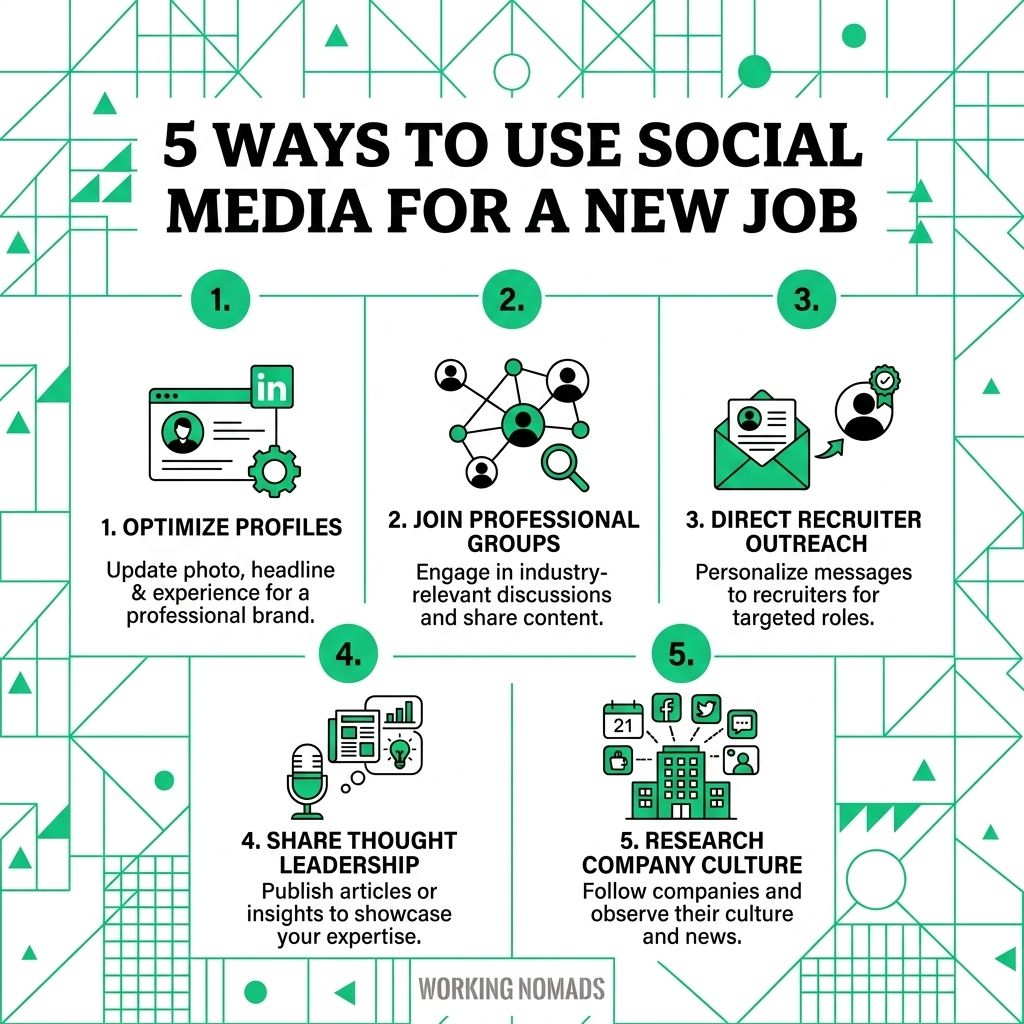
5 Ways to Use Social Media for a New Job
The hidden trap of social media job search
Social media can help your job search, but only when your profile makes your value easy to understand. A vague bio, old job title, private portfolio, and random posts will not give recruiters much to work with.
Use social platforms to show your skills, follow target employers, join relevant groups, and make it easier for people to contact you. CareerOneStop recommends using employers’ social media pages to find job posts, learn about companies, and connect with them on its social media job search page.
Profile steps that make you easier to find
Each platform has a different job. Keep your message consistent, but adjust what you show based on how people use the site.
1. Use X for public signals and company updates
X can still be useful for following companies, recruiters, founders, industry writers, and hiring posts. Treat it as a public signal, not your whole job search.
- Input: A short bio, current target role, and portfolio or LinkedIn link.
- Output: A public profile that quickly explains what you do.
- Action plan:
- Add your target role, core skill, and location or remote preference.
- Link to your portfolio, resume page, or LinkedIn profile.
- Follow target companies and recruiters.
- Comment with useful context instead of asking strangers to hire you.
2. Make LinkedIn clear enough for recruiter search
LinkedIn is usually the most important social platform for job search. LinkedIn Help says #OpenToWork lets you choose whether all LinkedIn members or only recruiters can see that you are open to opportunities.
- Input: Job titles, skills, work samples, and target roles.
- Output: A profile that matches the jobs you want.
- Action plan:
- Turn on Open to Work with the right titles, locations, and job types.
- Rewrite your headline so it names the role you want, not just your current title.
- Add portfolio links or work samples to the Featured section.
- Ask past coworkers for specific recommendations.
3. Use Facebook groups with care
Facebook can help when your industry has active local groups, alumni groups, trade groups, or community hiring pages. Keep your public profile clean enough that a referral does not become awkward.
- Input: A personal profile and a list of relevant groups.
- Output: Better access to referrals, local openings, and informal leads.
- Action plan:
- Review what strangers can see on your profile.
- Join groups tied to your field, city, school, or license.
- Answer questions when you can be genuinely useful.
- Send direct messages only when you have a clear reason.
4. Share a simple online resume or portfolio
A PDF resume is still useful, but some work is easier to understand when people can click through it. Designers, writers, marketers, developers, analysts, and consultants often benefit from a simple online portfolio.
- Input: Resume, work samples, project links, and a short bio.
- Output: One link that shows your best proof.
- Action plan:
- Use a clean portfolio site, resume page, or personal website.
- Add only work samples you can explain in an interview.
- Keep private client details out unless you have permission.
- Put the same link on LinkedIn, X, and your email signature.
5. Join career communities that match your field
Job search feels harder when every step happens alone. Career communities can give you feedback, referrals, salary context, and a clearer sense of what employers are asking for.
- Input: A target role and a few communities tied to that role.
- Output: Better conversations with people who understand your field.
- Action plan:
- Join Slack groups, LinkedIn groups, Discord servers, or local professional groups.
- Ask specific questions about interviews, portfolios, or hiring needs.
- Share useful answers when you have real experience.
- Follow up with people who respond thoughtfully.
Platform strategy comparison
| Platform | Weak Approach | Stronger Approach |
|---|---|---|
| **X** | Random posts with no profile context | Clear bio, target role, and useful industry comments |
| **LinkedIn** | A copied resume with no direction | Targeted headline, Open to Work settings, and work samples |
| **Facebook** | Personal profile only | Relevant groups and careful public visibility |
| **Portfolio link** | Old PDF link with no context | Current work samples tied to your target role |
Social media will not replace a strong resume or direct applications. It can make you easier to find, easier to refer, and easier to trust before the first call.
For a related Working Nomads article, read how to demonstrate added value as a remote employee guide before you decide your next step.
What to Read Next
Read why find better opportunities and leave bad jobs guide if you want a related next step on career growth.
Use how to succeed in the remote hiring process guide when you need more context before your next decision.
Publishing Articles or Documentation? Remove AI Slop.
Remove repetitive AI filler phrases, robotic patterns, and AI slop to make your content human, engaging, and original.
Applying for Growth Marketing & SEO Specialist Roles?
Boost your callback rate with our 100% free ATS-optimized resume template tailored specifically for remote Growth Marketing & SEO Specialist positions.
Remote Growth Marketing & SEO Specialist Resume Template
Built for performance marketers and organic search experts scaling visitor-to-customer acquisition funnels.
ATS Keyword Scanner
Check your resume against remote job descriptions to find missing keywords and boost your score.
Tailored Cover Letter
Generate a personalized, high-converting remote cover letter emphasizing async communication.
Related market data
Remote Social Media salary and jobs
This article connects to live Working Nomads data for the closest matching remote job market. Salary figures use only active listings that publish usable compensation.
Matching jobs
11
Median salary
$83,200/yr
Salary samples
1