Resume Tips for Long Tenure at One Company
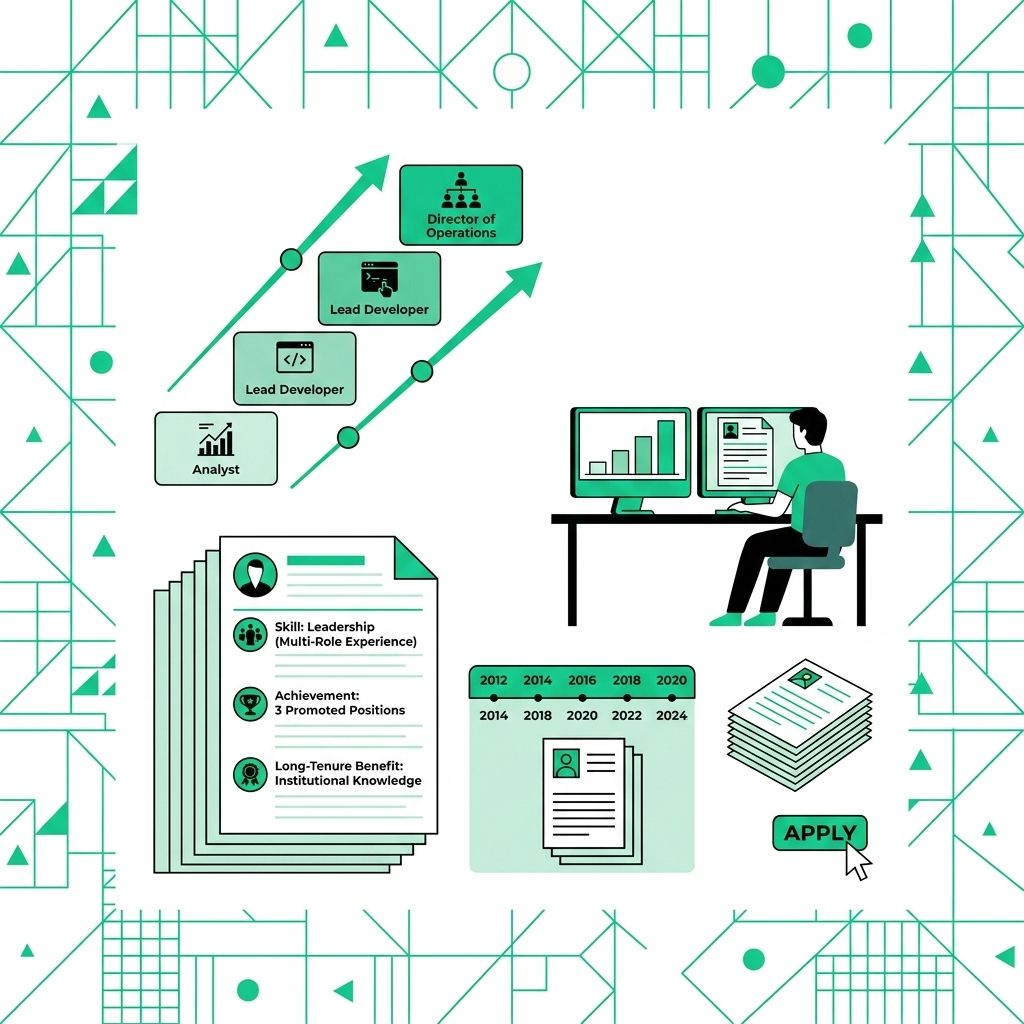
Turn Long Tenure Into a Strength
Staying with one company for many years can be a strength. It can show loyalty, trust, growth, and deep knowledge. The resume just needs to make that growth visible.
If the whole history appears as one long block, the reader may miss the promotions, changing responsibilities, new tools, and different problems you handled. Break the story into clear parts.
Reframe Your Company History
Treat your time at one company as a series of roles, projects, and changes. Show movement.
Break down your tenure
Do not list fifteen years under one title if your work changed during that time.
- Step 1: List each distinct role you held.
- Step 2: Add dates for each role to show progress.
- Step 3: Name the different responsibilities and achievements for each stage.
- Step 4: Summarize older or less relevant roles if they do not support the target job.
Input: One large employment block covering many years.
Output: A clear timeline with promotions, role changes, department moves, and current skills.
Career progression overview
Start the experience section with one line that frames the story. For example, "Earned three promotions across operations, customer support, and vendor management while leading process improvements across multiple teams."
Reduce Stagnation Concerns
Some employers may wonder whether a long-tenured candidate has kept skills current. AARP's guidance on age-proofing your resume recommends focusing on recent, relevant experience and showing skills instead of age signals.
Your resume should do the same. Show what you know now, not only what you did years ago.
Feature current skills
Remove stale tools and dated training unless they still matter for the role. Replace them with recent software, certifications, methods, projects, and industry involvement.
Put Your Best Proof Near the Top
Move the strongest wins to the first page. A reader should not have to dig through old titles to find your value.
- Identify the impact: Review project notes, performance reviews, and major outcomes.
- Quantify the result: Use numbers when they are accurate and allowed to share.
- Match the target: Choose achievements that connect to the role you want next.
Use a Professional Profile
Skip a generic career objective. Lead with a short profile that explains your current strengths, target role, and relevant proof.
Your long tenure is not the problem. The problem is a resume that hides your growth. Show progress, show current skills, and make the next employer see how your experience helps them now.
For a related Working Nomads article, read references on your remote resume and when to share them for your next step before you decide your next step.
What to Read Next
Read resume tips when you are overqualified if you want a related next step on resume writing.
Use why a one-page remote resume usually works best for your next step when you need more context before your next decision.
Publishing Articles or Documentation? Remove AI Slop.
Remove repetitive AI filler phrases, robotic patterns, and AI slop to make your content human, engaging, and original.
Applying for Senior Customer Support Specialist Roles?
Boost your callback rate with our 100% free ATS-optimized resume template tailored specifically for remote Senior Customer Support Specialist positions.
Remote Customer Support Specialist Resume Template
Highlights customer empathy, ticket resolution speed, Zendesk/Intercom power workflows, and self-serve documentation.
ATS Keyword Scanner
Check your resume against remote job descriptions to find missing keywords and boost your score.
Tailored Cover Letter
Generate a personalized, high-converting remote cover letter emphasizing async communication.