Adaptive Skills for Your Resume and Why They Matter
Why Static Resumes Fall Short
Technical skills matter, but they are not the whole story. Employers also want to know how you handle change, feedback, pressure, and people.
Adaptive skills help show that part of your work. They do not replace hard skills. They help explain how you use those skills when the job gets messy.
What Adaptive Skills Mean
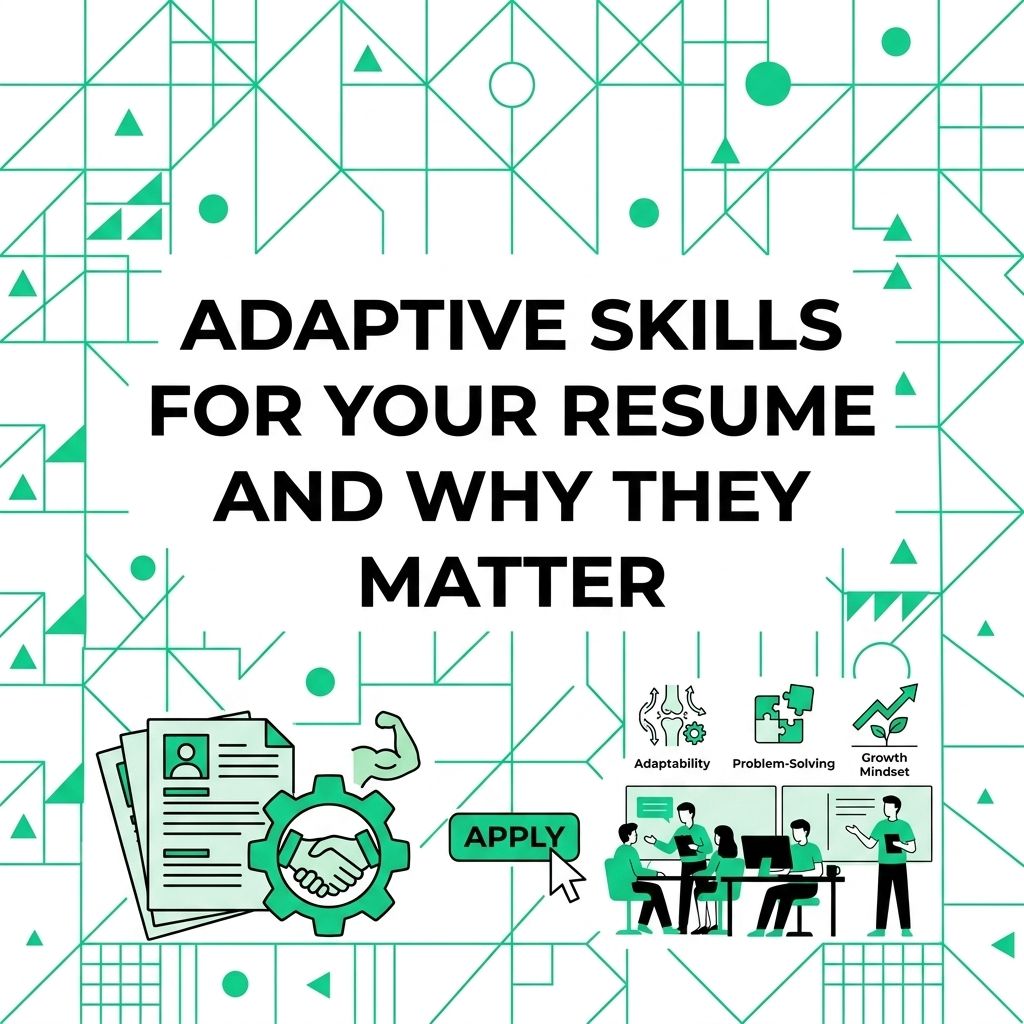
Adaptive skills are transferable habits and work behaviors. They help you learn new tools, work with different people, and respond when priorities shift.
O*NET describes adaptability as being open to and comfortable with change, new experiences, or ideas at work. Its soft skills list also includes interpersonal and thinking skills that help people work well and perform effectively.
Adaptive Skills to Add to a Resume
Do not simply list these words in a skills section. Connect each one to a real work example.
Collaborative teamwork
Show how you worked with others toward a shared result.
- Input: A team goal that required work across departments.
- Action: Shared updates, coordinated tasks, and helped remove handoff gaps.
- Output: A completed project with fewer delays.
- Resume phrasing: "Coordinated with cross-functional partners to complete project handoffs on schedule."
Continuous learning
Show how you learned something useful and applied it.
- Input: A new rule, tool, process, or client need.
- Action: Completed training, tested the process, and used it on live work.
- Output: Faster adoption and fewer mistakes.
- Resume phrasing: "Learned new reporting software and used it to improve weekly status updates."
Technology comfort
Show that new systems do not stop your progress.
- Input: A new project management system.
- Action: Learned the interface and helped teammates follow the new workflow.
- Output: Smoother team adoption.
- Resume phrasing: "Adopted a new tracking system and helped the team keep project updates current."
Problem solving
Show that you can handle issues without waiting for every answer.
- Input: A delay, error, customer concern, or missing resource.
- Action: Found options, raised the right issue, and followed through.
- Output: A resolved problem or a clearer next step.
- Resume phrasing: "Resolved supply delays by comparing vendor options and updating the delivery plan."
Feedback and resilience
Show that you can use feedback without getting stuck in defensiveness.
- Input: Manager feedback or a project review.
- Action: Adjusted the process and tracked the next result.
- Output: Better quality, fewer errors, or faster turnaround.
- Resume phrasing: "Used manager feedback to improve review quality and reduce repeat edits."
Prove Adaptability With Examples
Adaptive skills work best inside bullet points. Pair the trait with an action and a result.
Instead of writing "adaptable," show the moment you adapted. That gives the employer proof instead of a label.
For a related Working Nomads article, read references on your remote resume and when to share them questions to ask before you decide your next step.
What to Read Next
Read how to explain a gap year on your resume if you want a related next step on resume writing.
Use why a one-page remote resume usually works best questions to ask when you need more context before your next decision.
Publishing Articles or Documentation? Remove AI Slop.
Remove repetitive AI filler phrases, robotic patterns, and AI slop to make your content human, engaging, and original.
Applying for Universal Remote Professional Roles?
Boost your callback rate with our 100% free ATS-optimized resume template tailored specifically for remote Universal Remote Professional positions.
Classic ATS-Friendly Standard Resume Template
A pure single-column structure with standard semantic headings (Summary, Experience, Skills, Education) that passes every automated applicant scanner.
ATS Keyword Scanner
Check your resume against remote job descriptions to find missing keywords and boost your score.
Tailored Cover Letter
Generate a personalized, high-converting remote cover letter emphasizing async communication.