Differences Between Companies in Europe and the US
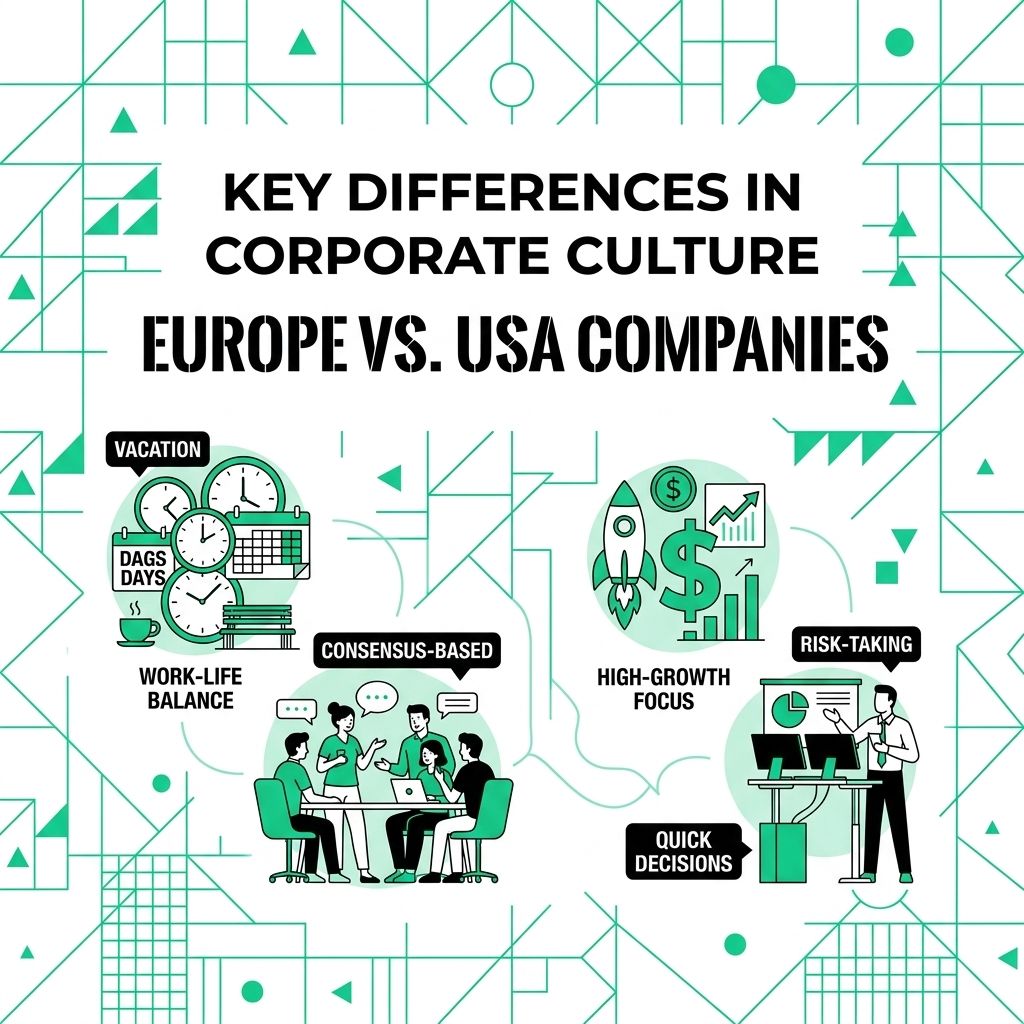
European and US companies can feel different, but the details depend on the country, company, role, and industry. Do not treat either side as one fixed culture.
For a related Working Nomads article, read why your attitude dictates your career trajectory for beginners before you decide your next step.
Still, a few patterns matter when you compare offers. Time off, health benefits, pay mix, work hours, and feedback style can vary a lot.
Compare Paid Time Off Rules
Paid leave is one of the clearest differences. The EU says employees are entitled to at least four weeks of paid holiday per year, while the US Department of Labor says the Fair Labor Standards Act does not require payment for time not worked, such as vacation or holidays.
Source: EU annual leave rules
Source: US Department of Labor vacation leave guidance
- Read the contract Confirm how many days you get
- Ask about company norms Find out whether people actually take the time
- Check public holidays Compare paid holidays, office closures, and local rules
Review Pay and Equity Carefully
US tech companies may offer higher cash pay or more equity in some roles, especially in high-cost markets. European companies may offer stronger leave, public benefits, or more predictable protections.
Do not compare salary alone. Compare taxes, healthcare costs, pension or retirement support, paid leave, equity terms, and severance rules.
Look at Healthcare and Benefits
US workers often review employer health insurance as part of the offer. In many European countries, healthcare access is less tied to one employer.
This can change how risky a job move feels. A higher US salary may come with higher personal healthcare costs. A lower European salary may come with benefits that reduce your out-of-pocket risk.
Notice Work Hours and Boundaries
Some European teams are more protective of vacation and offline time. Some US teams move faster and expect more flexibility around deadlines.
These are patterns, not rules. Ask direct questions. When do people usually log off? How often do deadlines require late work? Do managers message people during vacation?
Ask About Feedback and Promotion
Feedback norms can vary by company more than by region. Some teams are direct. Some are indirect. Some promote quickly. Some require longer tenure.
Ask how performance is measured, how often reviews happen, and what promotion looks like for remote employees.
Compare Europe and US Company Offers
| Offer area | Common European pattern | Common US pattern |
|---|---|---|
| Paid time off | Legal minimums are often stronger | Often set by employer policy |
| Healthcare | Less tied to one employer in many countries | Often part of the job benefits package |
| Pay mix | May lean more toward salary and benefits | May include more equity in tech roles |
| Work pace | Often stronger vacation norms | Often faster growth expectations |
Choose based on the full offer, not a stereotype. Ask practical questions, compare the total package, and pick the setup that fits your life and career goals.
What to Read Next
Read what we can actually learn from billionaires if you want a related next step on career growth.
Use how to demonstrate added value as a remote employee guide for employers when you need more context before your next decision.
Publishing Articles or Documentation? Remove AI Slop.
Remove repetitive AI filler phrases, robotic patterns, and AI slop to make your content human, engaging, and original.
Applying for Growth Marketing & SEO Specialist Roles?
Boost your callback rate with our 100% free ATS-optimized resume template tailored specifically for remote Growth Marketing & SEO Specialist positions.
Remote Growth Marketing & SEO Specialist Resume Template
Built for performance marketers and organic search experts scaling visitor-to-customer acquisition funnels.
ATS Keyword Scanner
Check your resume against remote job descriptions to find missing keywords and boost your score.
Tailored Cover Letter
Generate a personalized, high-converting remote cover letter emphasizing async communication.